Have you ever wondered why some stainless steel parts stay shiny and rust-free for years, while others stain and corrode? The secret often lies in a final, crucial step called passivation. In simple terms, passivation is a chemical “clean-up” process that makes metals, especially stainless steel, more resistant to rust.
According to experts at zone3Dplus, this process doesn’t coat the metal. Instead, it helps the metal protect itself by boosting its natural shield.
How Does Passivation Work?
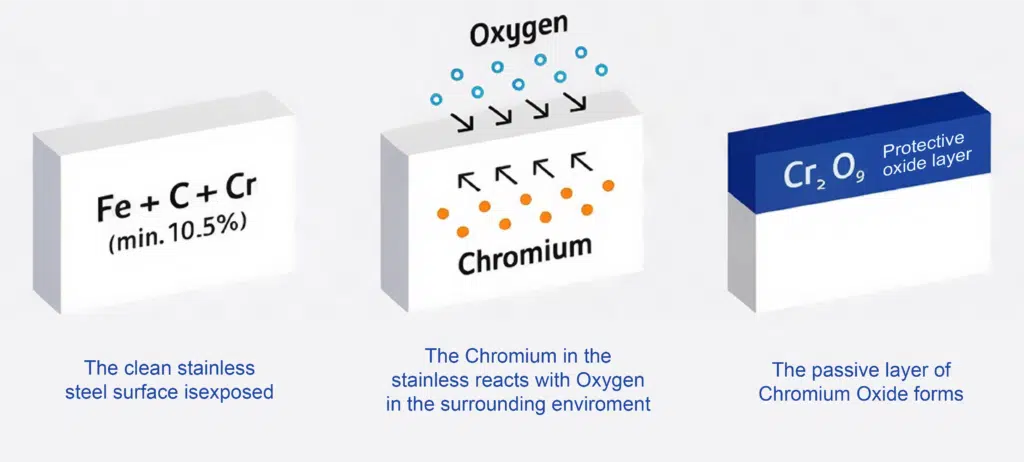
First, it helps to know that stainless steel is already rust-resistant because of chromium inside it. When chromium meets air, it forms a super thin, invisible shield called a chromium oxide layer. This shield blocks rust.
However, during manufacturing, things like dirt, grease, or tiny iron particles from tools can stick to the metal’s surface. These contaminants weaken the natural shield. Therefore, passivation cleans this surface away.
Here is a basic step-by-step of the passivation process:
1.Thorough Cleaning: The part is first cleaned to remove all oils, grime, and dirt.
2.Acid Bath: Next, the part is soaked in a mild acid solution, usually citric or nitric acid.
3.Rinsing and Finishing: Finally, the part is rinsed with water and dried completely.
As a result, the acid removes the embedded iron and other contaminants without harming the stainless steel itself. This allows the chromium in the metal to fully react with oxygen in the air and form that perfect, uniform protective shield.
Why You Should Consider Passivation
Ultimately, the main goal is to prevent corrosion (rust). But the advantages go further:
- Longer Part Life: Passivated parts last much longer, even in wet or harsh environments.
- Better Cleanliness: By removing tiny surface particles, the metal becomes smoother and easier to keep clean. This is especially important for medical devices, food processing tools, and aerospace parts.
- Improved Looks: It helps prevent surface staining and keeps that classic, clean stainless steel look.
- Low Cost & Effort: Compared to coatings like paint or plating, passivation is a very affordable way to get big durability benefits.
Where is Passivation Used?
You’ll find passivated parts in many industries where failure is not an option. For example:
- Medical and Surgical Tools: Implants and instruments must be ultra-clean and non-corrosive.
- Aerospace and Aviation: Plane components face extreme conditions.
- Food and Beverage Equipment: Machinery must be safe, sanitary, and rust-free.
- Marine Applications: Parts exposed to saltwater need maximum protection.
- High-Precision Automotive Parts: For performance and longevity.
Passivation vs. Other Finishes: What’s the Difference?
People often confuse passivation with other finishes. However, they are not the same.
- Passivation vs. Anodizing: Anodizing (used on aluminum) creates a much thicker, added oxide layer. Passivation simply improves the metal’s own natural layer.
- Passivation vs. Plating: Plating, like chrome plating, adds a completely new layer of a different metal on top. Passivation does not add a layer; it enhances the surface of the existing metal.
- Passivation vs. Pickling: Pickling also uses acid, but it removes scale and weld discoloration from hotter processes, making it more aggressive than the gentler passivation.
In short, think of passivation as a therapeutic treatment for the metal’s skin, not a new coat of paint.
FAQs About Passivation
Q: Does passivation make the metal thicker?
A: No. In fact, it might remove a tiny amount of surface material, but it does not add any measurable thickness.
Q: Can you see or feel the passivation layer?
A: No. The chromium oxide layer is only 1-3 nanometers thick—completely invisible and undetectable by touch.
Q: Is passivation safe for food-grade and medical parts?
A: Yes. When done correctly with the right acids and controls, it is the standard finish for these sensitive applications.
Q: Do all stainless steel parts need passivation?
A: Not always, but it is highly recommended for maximum corrosion resistance, especially after machining or welding.
Final Thoughts
To summarize, passivation is a vital, final step for stainless steel parts that need to last. It’s a smart, cost-effective process that uses chemistry to unlock the metal’s full rust-proof potential. By removing contaminants, it allows the stainless steel to form its best possible protective shield.
If you are designing or manufacturing parts that face moisture, chemicals, or need to stay pristine, specifying passivation is a simple choice for a stronger, more reliable finish.
Multi Material 3D Printing: Reduce Waste Effectively
If you are researching a tool changer 3D printer, you are probably trying to solve one of two problems: printing...
Multi Material 3D Printing: How to Choose the Right Process for Functional Parts
Multi material 3D printing is changing how teams build prototypes and end-use parts. Instead of treating a printed part as...
Multi Color 3D Printer vs Full-Color 3D Printing Service: Which Is Better for Your Project?
A multi color 3D printer is one of the most searched topics in consumer and professional 3D printing right now....