Multi-Axis CNC Machining: When 3-Axis Just Can’t Do the Job

CNC machining powers countless parts we rely on daily. For many jobs, the 3-axis CNC machine is the star—moving a cutting tool up/down, left/right, and forward/backward. It’s simple, efficient, and perfect for straightforward parts.

But what happens when designs get complicated? When you need tricky angles, smooth curves, or hard-to-reach spots—without flipping the part over and over? That’s when 3-axis hits its limit. The answer? Multi-axis CNC machining.

Think of it this way: 3-axis is like a hand that only moves in three directions. Multi-axis adds the “wrist” and “elbow,” letting the tool move from almost any angle. This extra flexibility changes everything.

When 3-Axis Isn’t Enough

1. Complex Shapes and Curves
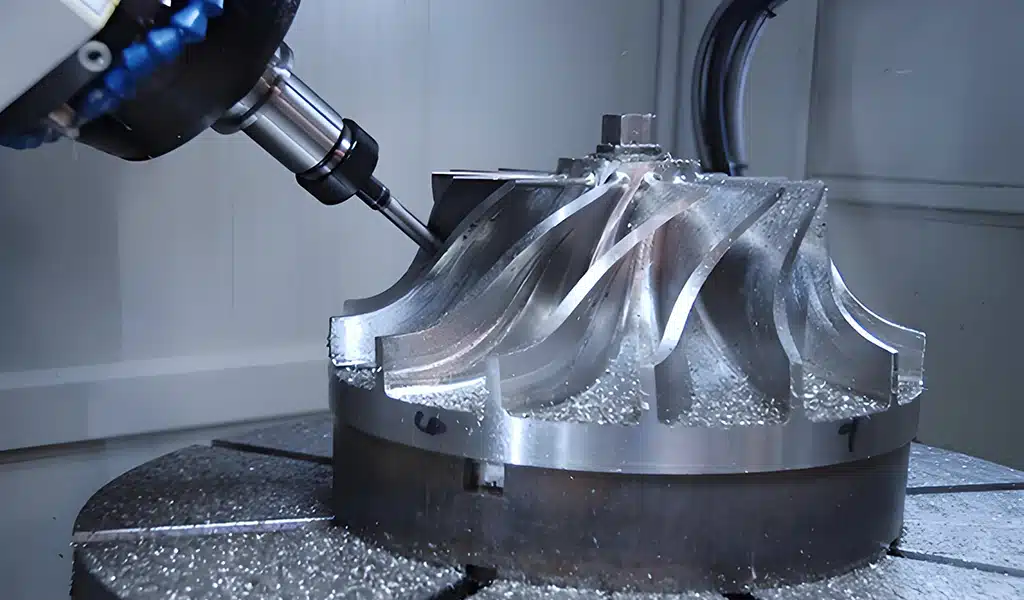
Parts like impellers, turbine blades, intricate molds, or sculpted surfaces need smooth, continuous tool paths. Multi-axis machines can follow these complex contours in one go—no awkward re-clamping.

2. Hidden Features (Undercuts)
If a feature hides beneath an overhang—like the inside of a bottle—3-axis can’t reach it. Multi-axis tools tilt and rotate to access those hard-to-reach areas.

3. Precision at Odd Angles
Need perfectly aligned holes or slots that aren’t parallel to any main axis? 3-axis requires multiple setups, each risking misalignment. Multi-axis does it all in a single setup.

4. Faster Production, Fewer Setups
Flipping and re-fixturing parts wastes time. Multi-axis—especially 5-axis—often completes the part in one go, cutting labor costs and boosting accuracy.

5. Superior Surface Finish
Instead of “stepping” along curves (which leaves ridges), multi-axis positions the tool at the best cutting angle for a smooth, clean finish straight off the machine.

6. Working with Tough Materials
For metals like titanium, optimal tool positioning is critical. Multi-axis keeps the tool in the perfect orientation, extending tool life and improving part quality.

Multi-Axis Options

4-Axis CNC
Adds rotation around the X-axis (A-axis). Ideal for cylindrical parts, cam lobes, or angled drilling without extra setups.

5-Axis CNC
Adds a second rotation axis (B or C). The tool can tilt and swivel, making it possible to machine highly complex parts—such as aerospace components, medical implants, and precision automotive parts—in one setup.

Why Switch to Multi-Axis?

  • Make More Complex Parts – If 3-axis can’t make it, multi-axis can.
  • Speed Up Production – Fewer setups mean faster turnaround.
  • Boost Accuracy – One setup keeps everything perfectly aligned.
  • Get Better Finishes – Optimal tool angles create smoother surfaces.
  • Lower Long-Term Costs – Faster production, less scrap, and fewer fixtures save money.
  • Unlock Design Freedom – Engineers can design without traditional manufacturing limits.

Multi-Axis CNC at zone3Dplus

At zone3Dplus, we combine the precision of multi-axis CNC machining with advanced 3D printing capabilities. This gives you unmatched flexibility—whether you need tight-tolerance aerospace parts, complex molds, or custom prototypes.

Our multi-axis service offers:

  • High-precision machining for both metals and plastics.
  • One-stop production—from CAD model to finished part.
  • Expert advice to choose the most cost-effective method (CNC or 3D printing).

From tricky undercuts to fully contoured surfaces, zone3Dplus delivers parts that other shops can’t. Whether it’s a single prototype or a full production run, our multi-axis machining ensures accuracy, efficiency, and top-tier quality.

Is Multi-Axis Right for You?

If your parts are simple blocks or plates, stick with 3-axis—it’s faster and cheaper. But if your designs have curves, angles, undercuts, or need multiple sides machined, multi-axis is your best choice.

Don’t let limited equipment hold back your designs. With zone3Dplus multi-axis CNC machining, you can create smarter, stronger, and more precise parts—faster.

Scroll to Top