
When you choose a material for your 3D projects, you likely have one big question: Is TPU toxic?
TPU, which stands for Thermoplastic Polyurethane, is a hugely popular material. It’s flexible, durable, and people use it for everything from phone cases to wristbands. Naturally, you want to know it’s safe for you and your family to touch and use daily.
Therefore, this guide will clearly explain the safety of TPU, from how it’s made to how you can safely use it in your home or shop. We’ll also highlight how professionals, like the team at zone3Dplus, use this material for professional and safe products.
What is TPU and Why Is It So Popular?
First, let’s look at what TPU is. TPU is a type of elastomer. Think of it as being between a hard plastic and soft rubber.
Specifically, this unique structure gives it a great combination of flexibility, strength, and resistance to scratches. In short, these traits make it perfect for items that need to bend, stretch, or absorb impact without breaking.
Furthermore, its popularity is thanks to its ease of use. It works with most common 3D printers and is generally easier to print than other flexible filaments. Consequently, for hobbyists and engineers who need a tough, flexible material, TPU is often the number one choice.
Is TPU Toxic While You're Printing?
A major safety concern is what happens when you heat the filament. As you know, many plastics release fumes when they melt, which is a valid worry.
The good news is this: TPU is considered one of the safer filaments to print. Most standard TPU materials do not contain styrene, which is a dangerous chemical found in materials like ABS.
Instead, when heated, TPU mainly releases a compound called caprolactam.
What is Caprolactam?
This substance has a low odor, meaning you can smell it even at very tiny amounts. While the smell might be noticeable, it is generally viewed as low in toxicity at the levels produced during normal 3D printing.
Essential Safety Rule
However, you should never assume any fume is completely safe. Therefore, the most important rule for safe printing is to always run your 3D printer in a well-ventilated area. Using an enclosed printer with a filter or a dedicated fan hood is strongly suggested to reduce any breathing risk.
Finished Product Safety: Safe to Touch?
Once your print is done and has cooled, the safety profile improves significantly. Solid, cool TPU is generally inert and non-toxic to touch.
This is why it is perfectly safe for everyday applications such as:
- Phone cases and grips.
- Wearable bands for watches or fitness trackers.
- Household items and tool grips.
- Children’s toys (though supervision is always needed for young kids).
A Note on Food Safety
Even though solid TPU is non-toxic, it is not automatically safe for food.
The reason is simple: The 3D printing process creates tiny layers and grooves where bacteria can grow. Moreover, the material may not be officially certified to handle food acids or fats. For this reason, you should not use 3D-printed TPU items for direct food or drink contact (like cups or plates) unless the specific filament is clearly marked as food-safe and you keep it very clean.
Environmental and Disposal Facts
Beyond your personal safety, it’s important to think about the environment. TPU is a type of plastic, and like most plastics, it does not break down easily in nature. If it goes to a landfill, it will stay there for a very long time.
Consequently, proper disposal is key. Though not all local recycling centers accept TPU, it is technically recyclable. You should always check with your local facility for specific instructions.
TPU vs. Other Common Filaments
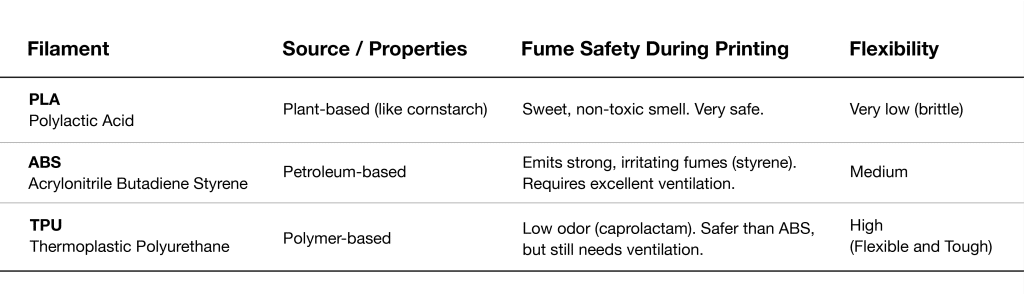
To fully grasp TPU’s safety, it helps to compare it to two other popular materials:
In summary, TPU offers a great middle ground—safer printing fumes than ABS, with the flexibility and toughness that PLA doesn’t offer.
zone3Dplus: Using TPU for Professional Safety and Quality
Knowing the science of a material is one thing; applying it professionally is another. This is where the expertise of companies like zone3Dplus becomes crucial.
zone3Dplus’s Professional Approach to TPU
zone3Dplus is a leader in high-precision 3D printing, specifically using materials like TPU to meet demanding industry needs.
Specifically, they ensure TPU is used correctly for end-use products by focusing on:
Strict Material Sourcing: They use certified, high-grade TPU filaments that meet professional standards for consistency and low-toxicity.
- Advanced Process Control: They use industrial-grade, enclosed machines with robust air filtration. This means that any trace fumes are captured, ensuring a safe workplace and consistent material performance.
- Real-World Applications: They leverage TPU’s specific strengths to create:
- Custom Seals and Gaskets: These require exact flexibility and a guaranteed seal in machinery.
- Consumer Electronics Components: Items that need to be drop-resistant and flexible, mimicking the final product.
- Automotive/Robotics Parts: Where specific shock absorption and resistance to wear are critical.
By utilizing professional-grade equipment and strict production rules, zone3Dplus shows how TPU can be safely and effectively used to create reliable, high-performance parts that meet commercial product development standards.
Conclusion: Your Final Safety Checklist
So, to answer the main question: Is TPU toxic?
The evidence confirms that TPU is a largely safe material for everyday use once it has been printed. The critical precautions are needed only during the melting and printing process itself.
Here are your four key safety takeaways:
- Ventilate When Printing: Always print in a well-ventilated space to scatter any fumes quickly.
- Handle Cooled Prints Confidently: Solid TPU objects are safe to touch and use for most common items.
- Avoid Food Contact: Never use 3D-printed TPU for items that will hold food or drink unless the filament is certified food-safe.
- Consider zone3Dplus for Critical Parts: For items that require the highest standards of safety and performance (like medical or industrial parts), use an expert service like zone3Dplus to ensure quality.
By following these simple rules, you can safely enjoy all the creative and practical benefits that TPU filament offers!
Multi Material 3D Printing: Reduce Waste Effectively
If you are researching a tool changer 3D printer, you are probably trying to solve one of two problems: printing...
Multi Material 3D Printing: How to Choose the Right Process for Functional Parts
Multi material 3D printing is changing how teams build prototypes and end-use parts. Instead of treating a printed part as...
Multi Color 3D Printer vs Full-Color 3D Printing Service: Which Is Better for Your Project?
A multi color 3D printer is one of the most searched topics in consumer and professional 3D printing right now....