
CNC machining has been a trusted manufacturing method for decades. It is accurate, strong, repeatable, and widely used across industries. But as product designs become more complex and development cycles get shorter, many engineering teams are asking a practical question: when does metal 3D printing make more sense than CNC?
The answer is not “one is better than the other.” The better question is: which process fits the part, the budget, the timeline, and the production volume?
At zone3Dplus, we support both CNC machining and 3D printing services, including SLM / DMLS metal printing, SLA, SLS, MJF, PolyJet, vacuum casting, and low-volume manufacturing. That gives customers more flexibility when choosing the right route for prototypes, functional parts, and small production runs.
CNC Machining vs Metal 3D Printing: The Core Difference
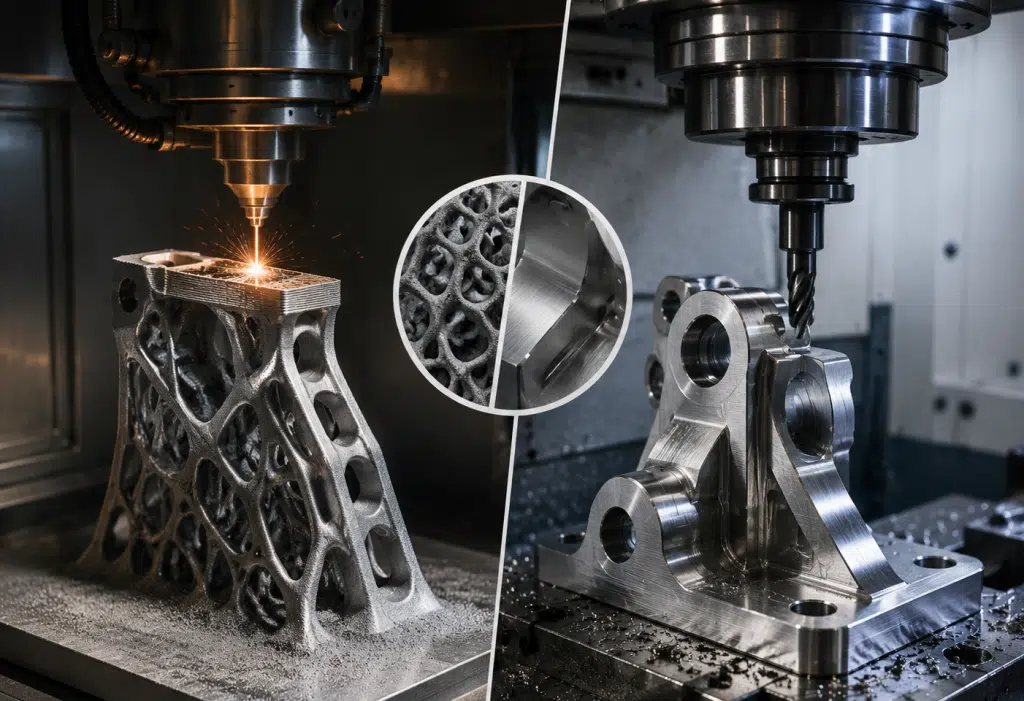
CNC machining is a subtractive process. It starts with a solid block of metal or plastic, then cuts away material until the final shape is formed. This makes CNC a strong choice for parts that need tight tolerances, smooth surfaces, and proven material performance.
Metal 3D printing is an additive process. Instead of removing material, it builds a part layer by layer from metal powder. Technologies such as SLM and DMLS use a laser to fuse metal powder into dense, functional metal parts.
This difference changes what each process does best.
CNC is often better for simple geometries, high-precision surfaces, and parts that require standard billet materials. Metal 3D printing is often better for complex shapes, lightweight structures, internal channels, custom parts, and low-volume production where tooling or complex machining would slow the project down.
When Metal 3D Printing Makes Sense
A metal 3D printing service makes the most sense when the design would be difficult, expensive, or impossible to make with traditional machining.
For example, parts with internal cooling channels, lattice structures, organic shapes, thin walls, or consolidated assemblies can be a better fit for additive manufacturing. Instead of machining several parts and assembling them later, metal 3D printing can sometimes produce the part as one integrated component.
This can help engineering teams reduce assembly steps, lower part weight, and test more advanced designs before moving into mass production.
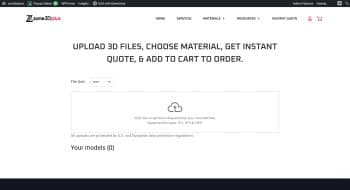
Metal 3D printing also works well for short-run production. If you only need one prototype, five test parts, or fifty custom components, CNC setup and tooling time may not be the most efficient route. With zone3Dplus, customers can upload a 3D model, request an instant quote or RFQ support, and choose the technology, material, finishing, and quantity based on the project.
When CNC Still Makes More Sense
CNC machining is still the better option for many parts.
If the design is simple, the material is easy to machine, and the required quantity is higher, CNC can be more cost-effective. It is also a strong choice when a part needs very tight tolerances, excellent surface finish, or mechanical properties from wrought metal stock.
For flat plates, simple brackets, shafts, housings, and precision fixtures, CNC may be the more practical choice. It can also work well after 3D printing as a secondary process. Many metal printed parts are post-machined in critical areas to improve tolerance, fit, thread quality, or surface finish.
This is why a single manufacturing method is rarely the whole answer. A supplier that offers both industrial 3D printing services and CNC machining can help buyers choose the right process instead of forcing every part into one workflow.
Custom Parts: Where Additive Manufacturing Has an Advantage
For custom parts, additive manufacturing has a clear advantage: it does not require tooling.
That matters when a design is still changing. Product teams often need several rounds of testing before the final version is ready. A bracket may need to be lighter. A housing may need better airflow. A robotic gripper may need a custom shape for a specific application. A spare part may no longer be available from the original supplier.
In these cases, a custom 3D printing service can help companies move faster. Instead of waiting for molds, fixtures, or long machining setup, buyers can upload STL, STP, or STEP files and move directly into manufacturability review and production.
zone3Dplus supports custom metal and plastic 3D printing with no minimum order quantity for 3D printing projects. This makes it easier to test one part before ordering a larger batch.
Online Quoting Helps Teams Compare Options Faster
One of the reasons buyers look for an online 3D printing service is speed. Waiting days for a manual quote can slow down product development, especially when several design versions need to be compared.
zone3Dplus provides an online instant quote workflow where customers can upload 3D files, select technology, material, finishing, and quantity, then review pricing and production options. For more complex projects, RFQ support and DFM analysis help check printability, material fit, and manufacturing risk before production begins.
This is especially useful when comparing CNC and metal 3D printing. The same part may be possible with both methods, but the best choice depends on geometry, tolerance, surface finish, volume, and end use.
Practical Examples
Choose metal 3D printing when you need:
- Lightweight brackets with lattice or topology-optimized structures
- Internal channels for cooling or fluid flow
- Custom titanium, aluminum, stainless steel, or superalloy parts
- Low-volume metal components without tooling
- Functional prototypes that need real metal performance
- Replacement parts or custom industrial components
Choose CNC machining when you need:
- Very tight tolerances on simple or medium-complexity parts
- Smooth machined surfaces
- Strong parts from standard metal or plastic stock
- Higher-volume production of simpler geometries
- Post-processing for printed parts, such as threads, bores, or sealing faces
The Best Choice Often Combines Both
The strongest manufacturing strategy is not always “3D printing or CNC.” In many cases, it is both.
A part can be metal 3D printed to achieve a complex shape, then CNC machined in critical areas for precision. A prototype can be printed first, tested, revised, and later moved to CNC or vacuum casting when the design and quantity are ready. For low-volume production, 3D printing may remain the best option. For higher volumes, another process may become more economical.
zone3Dplus supports this kind of practical decision-making by offering 3D printing, CNC machining, vacuum casting, hybrid manufacturing, and low-volume manufacturing services under one manufacturing workflow.
Final Thoughts
Metal 3D printing makes sense when design freedom, low volume, customization, and fast iteration matter more than traditional machining efficiency. CNC makes sense when precision, surface finish, material stock, and repeatability are the main priorities.
For engineering teams, the goal is not to choose the trendiest process. The goal is to get the right part made in the right way.
If your project involves complex geometry, low-volume production, or custom metal parts, zone3Dplus can help you compare additive manufacturing and CNC options before production begins.
What Files Do You Need for a 3D Printing Quote?
Getting a fast and accurate 3D printing quote starts with one thing: the right file.A good 3D file helps the...
How 3D Printing Helps Reduce Prototype Lead Time
Prototype delays rarely come from one big problem. More often, they come from several small delays stacked together: waiting for...
How to Choose the Right 3D Printing Material for Functional Parts
Choosing the right 3D printing material is one of the most important decisions in any functional part project. A good...