Have you ever wondered how a block of metal turns into a precise car part or a complex piece of a machine? Often, the answer is milling. It’s one of the most common ways to make things in the manufacturing world.
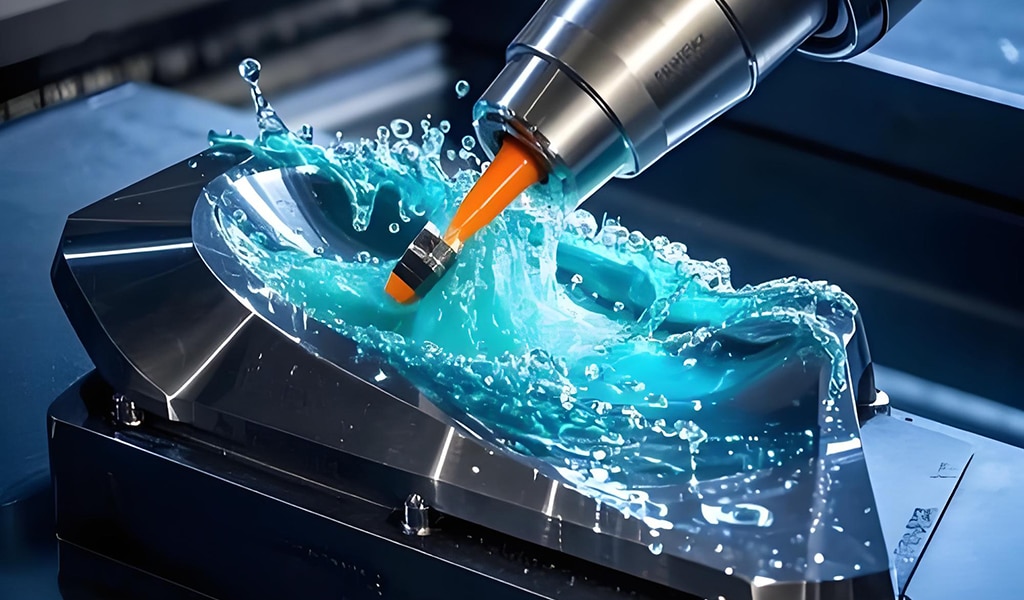
But what exactly is milling? In short, it’s a cutting process that uses a spinning tool to carefully shave away material from a solid block. The goal is to create a specific shape or part. Think of it like a super-powerful, ultra-precise version of a woodworker carving a piece of wood.
Today, this process is mostly done by computer-controlled machines, which we call CNC Milling. This means the entire operation is automated for perfect accuracy every time.
How Does CNC Milling Actually Work?
First, a designer creates a 3D model of the part on a computer. Next, special software translates that model into instructions, called G-code, for the milling machine.
After that, a worker secures a block of material (called the “workpiece”) onto the machine’s platform. Then, the machine gets to work. The spinning cutting tool, known as a “mill” or “end mill,” moves along multiple axes to cut the material.
Basically, the machine follows the digital instructions to remove material bit by bit until the final part is formed.
What are the Main Types of Milling?
You can often group milling by the direction the tool spins compared to the material’s movement. The two most common types are:
- Peripheral Milling: Here, the tool’s axis runs parallel to the surface being cut. It’s often used for cutting deep slots or contouring surfaces.
- Face Milling: In this case, the tool’s axis is perpendicular to the workpiece. Instead, the cutting is done by teeth on the tool’s tip and sides. This method is excellent for creating flat surfaces.
Furthermore, CNC milling machines themselves can be categorized by how many directions they can move. For instance, 3-axis machines move in three directions (X, Y, Z), which is great for simpler parts. On the other hand, 5-axis machines can rotate and move in more ways, allowing them to create incredibly complex geometries in a single setup.
Why is Milling Such a Popular Choice?
There are many good reasons why companies rely on milling for their projects. Here are a few key benefits:
- Excellent Material Choices: You can mill a huge range of materials, including metals like aluminum and steel, plastics, and even wood.
- High Precision and Accuracy: Because it’s computer-controlled, CNC milling can create parts with extremely tight tolerances and smooth surfaces.
- Great for Strong Parts: Milled parts are typically very strong and dense since they are made from a solid block of material.
- Fast Production: Once the machine is set up, it can produce parts very quickly. This makes it ideal for both one-off prototypes and larger production runs.
Milling vs. 3D Printing: Which is Better?
This is a common question. The truth is, both are amazing technologies, but they serve different purposes.
Milling is a subtractive process. It starts with a solid block and cuts away material. Because of this, the final part is very strong and has excellent mechanical properties from the start.
3D Printing is an additive process. It builds a part layer by layer from nothing. This is fantastic for creating shapes that are impossible to mill and for making quick, low-cost prototypes.
So, the best choice depends on your project. If you need a durable, high-precision part from metal, milling is often the better option. However, if you need a complex, lightweight prototype quickly, 3D printing might be the way to go.
What Can You Make with Milling?
The applications are almost endless! You can find milled parts in:
- Automotive: Engine components, gears, and brackets.
- Aerospace: Lightweight but strong structural parts.
- Medical: Precise surgical tools and implants.
- Consumer Electronics: Housings for phones and laptops.
Conclusion
In summary, CNC milling is a vital, versatile, and powerful manufacturing process. It transforms digital designs into high-quality, real-world parts with incredible accuracy. Whether you’re creating a prototype or producing thousands of components, milling offers the reliability and strength needed for success.
Ready to bring your project to life? zone3Dplus provides professional CNC milling services to help you create perfect parts. Visit our blog for a deeper dive into the world of milling and discover how we can help with your manufacturing needs
Multi Material 3D Printing: Reduce Waste Effectively
If you are researching a tool changer 3D printer, you are probably trying to solve one of two problems: printing...
Multi Material 3D Printing: How to Choose the Right Process for Functional Parts
Multi material 3D printing is changing how teams build prototypes and end-use parts. Instead of treating a printed part as...
Multi Color 3D Printer vs Full-Color 3D Printing Service: Which Is Better for Your Project?
A multi color 3D printer is one of the most searched topics in consumer and professional 3D printing right now....