For centuries, investment casting—also known as lost-wax casting—has shaped intricate metal parts for jewelry, aerospace, and automotive industries. But traditional methods rely on handmade wax patterns. These are time-consuming, expensive, and prone to errors.
Now, 3D printing is changing the game. By replacing wax patterns with 3D-printed ones, manufacturers can speed up production, cut costs, and achieve design freedom like never before. Here’s how 3D printing integrates with investment casting and why services like zone3Dplus are leading this revolution.
How 3D Printing Enhances Investment Casting
Instead of sculpting wax molds by hand or using costly tooling, 3D printers create precise patterns directly from CAD files. This digital approach unlocks:
- Faster lead times (from weeks to days)
- Lower production costs (no need for tooling)
- Complex designs that are impossible with manual methods
Key 3D Printing Technologies for Investment Casting
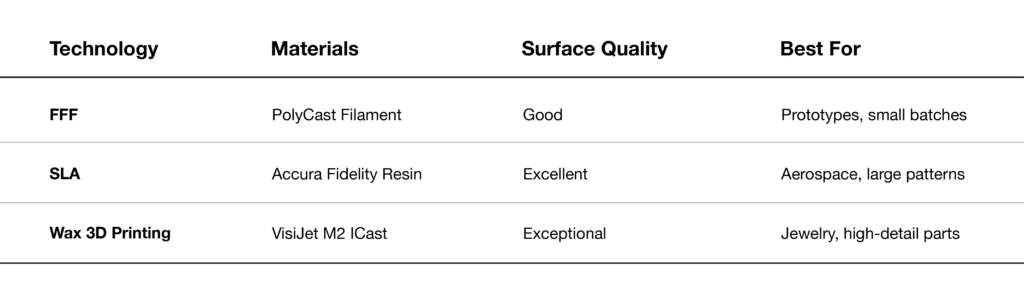
1.Fused Filament Fabrication (FFF) with Casting-Specific Filaments
Materials: PolyCast Filament
Best for: Prototypes and small batches
- Prints patterns with minimal ash (<0.003%) for clean burnout.
- Scale designs (1.007x–1.030x) to offset shrinkage during metal solidification.
- Surface finish: Good (may need post-processing for smoother results).
2.Stereolithography (SLA) with QuickCast Resins
Materials: Accura Fidelity Resin
Best for: Medium-to-large patterns needing high precision
- Produces hollow, lightweight patterns with ultra-low ash (<0.010%).
- Ensures dimensional stability for aerospace-grade parts like turbine blades.
- Surface finish: Excellent.
3.Dedicated Wax 3D Printing
Materials: VisiJet M2 ICast (RealWax™)
Best for: Jewelry and intricate industrial parts
- 100% wax material integrates seamlessly with foundry workflows.
- Eliminates post-casting machining thanks to superior surface quality.
- Surface finish: Exceptional.
Technology Comparison Table
Important Considerations for 3D-Printed Patterns
- Shrinkage Compensation: Scale your design (e.g., 1.025x for steel) to account for metal contraction.
- Surface Smoothing: Use alcohol vapor polishing or devices like the Polysher to remove layer lines.
- Material Storage: Keep PolyCast and wax filaments dry (<20% humidity) to avoid defects.
- Simulation Tools: Software like AnyCasting helps design gating systems for defect-free fills.
Step-by-Step: The 3D-Printed Investment Casting Process
1.Design & Print: Apply shrinkage compensation and print the pattern.
2.Post-Process: Sand and polish for a smoother finish.
3.Assembly: Attach sprues to form the casting tree.
4.Shell Building: Dip in ceramic slurry to form the mold.
5.Burnout: Heat molds at 1600°F to vaporize the printed pattern.
6.Casting: Pour molten metal into the cavity.
Real-World Benefits of 3D Printing in Casting
Future Trends to Watch
- Microwave Sintering: Speeds up burnout for 3D-printed patterns.
- AI-Driven Simulation: Predicts flow and defects in real-time.
- Multi-Material Patterns: Combines rigid and spongy materials for optimized burnout.
Conclusion
3D printing has turned investment casting into a fast, cost-efficient, and highly flexible process. Foundries, designers, and engineers now innovate quicker, produce on demand, and cut down costs dramatically.
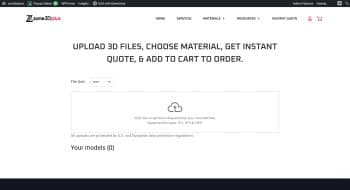
With services like zone3Dplus, you don’t need to invest in expensive equipment. Simply upload your CAD file, get an instant quote, and receive precision-made patterns ready for casting.
As 3D printing materials and technologies keep evolving, this synergy is set to transform industries from aerospace to custom jewelry.
Multi Material 3D Printing: Reduce Waste Effectively
If you are researching a tool changer 3D printer, you are probably trying to solve one of two problems: printing...
Multi Material 3D Printing: How to Choose the Right Process for Functional Parts
Multi material 3D printing is changing how teams build prototypes and end-use parts. Instead of treating a printed part as...
Multi Color 3D Printer vs Full-Color 3D Printing Service: Which Is Better for Your Project?
A multi color 3D printer is one of the most searched topics in consumer and professional 3D printing right now....