Ever wondered why a small piece of metal feels heavy, while a big cardboard box feels light? The answer is density. In simple terms, density tells us how much “stuff” is packed into a certain space.
Think of it like this: a pillow and a brick can be the same size, but the brick has a lot more mass squeezed into that space. That’s why the brick has higher density.
How Do You Calculate Density?
The formula for density is simple:
Density = Mass ÷ Volume
- Mass is how much matter is in an object.
- Volume is how much space it takes up.
So, if an object has a lot of mass in a small volume, it has high density. If it has little mass in a big volume, it has low density.
What Units Are Used for Density?
Density compares mass to volume. Common units are:
- Grams per cubic centimeter (g/cm³): Used for small solid objects, like metals.
- Kilograms per cubic meter (kg/m³): Used for larger volumes.
- Pounds per cubic foot (lb/ft³): Used in the Imperial system.
What Affects a Material’s Density?
Several factors change how dense a material is:
- Atomic Mass:Heavier atoms create denser materials. For example, gold atoms are much heavier than aluminum atoms.
- Atomic Packing:If atoms are tightly packed, like in metals, density is higher.
- Temperature:When materials heat up, they expand. This lowers density. Cooling makes them denser.
- Pressure:Gases change density a lot under pressure. Solids and liquids need extreme pressure to change.
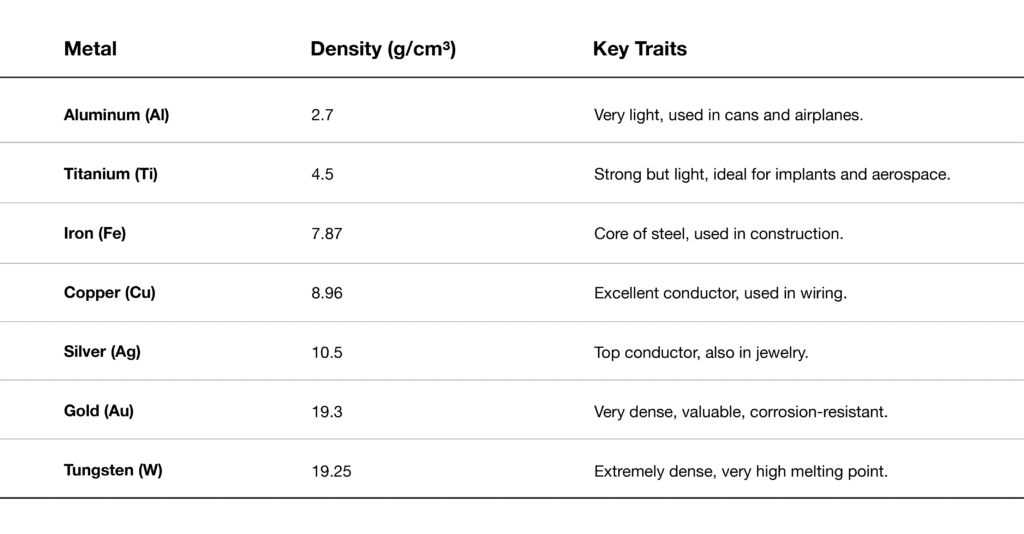
Density of Common Metals (Lightest to Heaviest)
Here’s a quick list of popular metals and how they compare:
Aluminum is the lightest, while gold is the heaviest.
What About Metal Mixtures (Alloys)?
Most metals we use are actually alloys (mixtures of metals). Examples include:
- Steel: Iron + carbon
- Brass: Copper + zinc
The density of an alloy depends on what’s inside:
- Adding a heavier metal (like zinc) makes the alloy denser.
- Adding a lighter metal (like aluminum) makes it less dense.
So, the final density is always a balance of its parts.
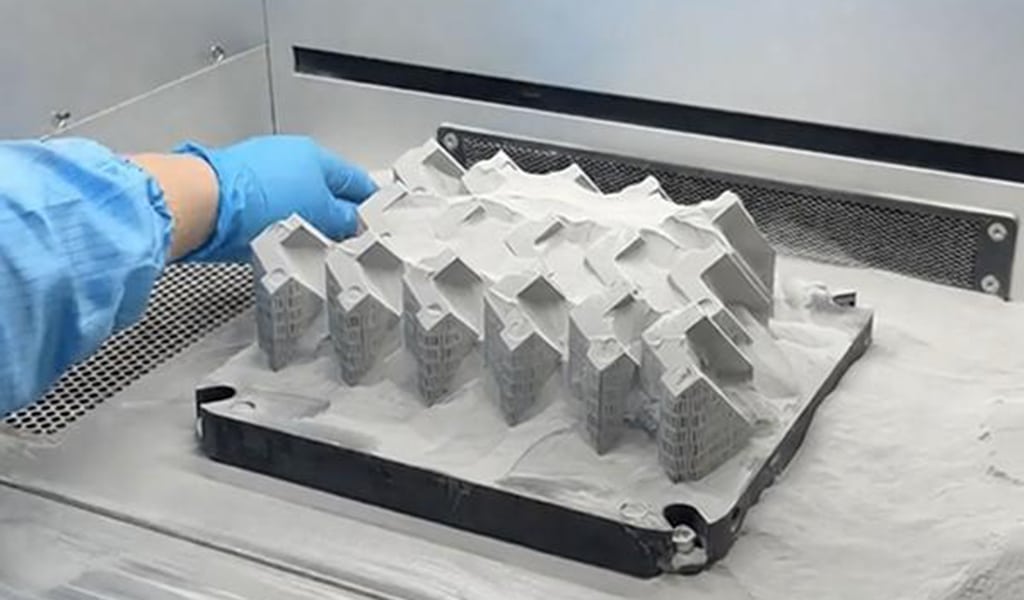
Metals and Alloys in 3D Printing
Metal 3D printing is transforming industries. Here are the most used materials:
- Stainless Steel (316L, 17-4PH): Strong, durable, and corrosion-resistant. Used in medical tools and marine parts.
- Aluminum Alloys (AlSi10Mg): Lightweight yet strong, perfect for cars and aircraft.
- Titanium Alloys (Ti-6Al-4V): High strength-to-weight ratio, biocompatible, used in aerospace and implants.
- Nickel Alloys (Inconel): Super-alloys that handle extreme heat and pressure, used in turbines and jet engines.
Why Choose zone3Dplus for Metal 3D Printing?
If you’re looking for a reliable partner, zone3Dplus makes metal 3D printing simple and cost-effective:
- Instant Online Quote System: Upload your CAD file and get a fast quote—no waiting.
- Expert Finishing Services: Options like polishing, plating, and post-processing for professional results.
- Trusted by Industries: Automotive, aerospace, medical, and consumer electronics companies rely on zone3Dplus for precision parts.
- Affordable Pricing: We make high-end metal printing accessible without cutting corners on quality.
Density explains why metals feel heavy, alloys shift properties, and material choice is crucial in 3D printing. If you want the right balance of performance and cost, zone3Dplus is your go-to partner for metal 3D printing.With zone3Dplus, you don’t just get a printed part—you get an engineered solution tailored to your project needs.
Multi Material 3D Printing: Reduce Waste Effectively
If you are researching a tool changer 3D printer, you are probably trying to solve one of two problems: printing...
Multi Material 3D Printing: How to Choose the Right Process for Functional Parts
Multi material 3D printing is changing how teams build prototypes and end-use parts. Instead of treating a printed part as...
Multi Color 3D Printer vs Full-Color 3D Printing Service: Which Is Better for Your Project?
A multi color 3D printer is one of the most searched topics in consumer and professional 3D printing right now....