Bronze vs. Copper vs. Brass

If you work with metals, you’ve likely encountered bronze, copper, and brass. But what exactly is the difference? In short, they are all part of the same “copper family,” but they have unique strengths and weaknesses.

Understanding these differences is key to picking the perfect material for your project. After all, the right metal can save you money, prevent failures, and ensure your product works perfectly. zone3Dplus provides a wide range of these materials, and knowing which one to choose is the first step to a successful build.

What Are They Made Of?

First, let’s break down what each metal is.

Copper: The Pure One

  • Unlike the others, copper is a pure element. This means it’s not mixed with other metals.
  • Key Fact: Because it’s pure, it’s the best at conducting electricity and heat.

Brass: The Shiny and Easy One

  • Brass is an alloy, which is a mix of two or more metals.
  • Main Ingredients: It’s mostly Copper and Zinc.
  • The amount of zinc changes the brass’s color and how easy it is to machine.

Bronze: The Strong and Tough One

  • Bronze is also an alloy.
  • Main Ingredients: It’s primarily Copper mixed with Tin.
  • Bonus: Other elements like phosphorus or nickel are sometimes added to make it even stronger or more corrosion-resistant.

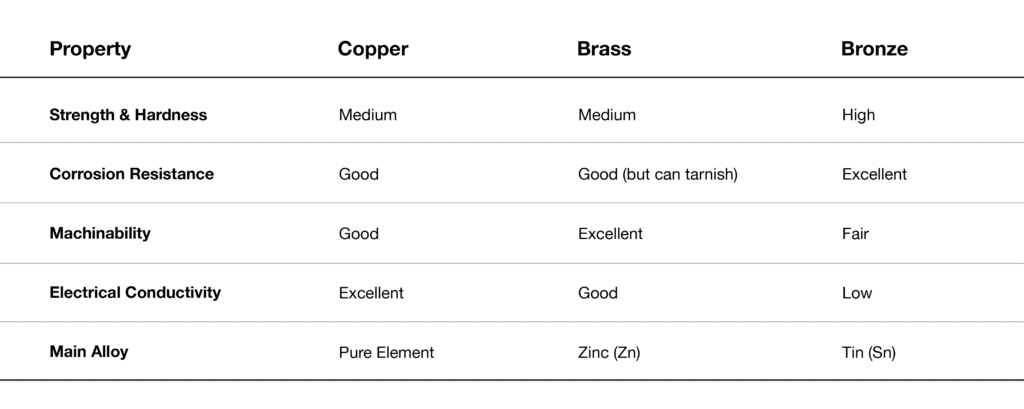
How Do They Compare? A Quick Look

This table gives you a fast, side-by-side comparison of their key features.

zone3Dplus

Picking the Right Metal for the Job

Your choice depends entirely on what you need the metal to do. Here’s a simple guide.

When to Use Copper

Copper is the top choice when you need to move electricity or heat efficiently.

  • Electrical Wires & Cables: Its superior conductivity is unmatched.
  • Plumbing Pipes: It resists corrosion and is safe for water.
  • Heat Exchangers & Cookware: It spreads heat quickly and evenly.

When to Use Brass

Brass is famous for being easy to work with and for its attractive gold-like look.

  • Decorative Items: Doorknobs, lamps, and musical instruments.
  • Easy-to-Machine Parts: Screws, valves, and fittings.
  • Electrical Connectors: Where very high conductivity isn’t the main concern.
  • zone3Dplus Insight: For projects requiring complex CNC machining, brass is often the most cost-effective choice due to its excellent machinability, which leads to faster production and less tool wear.

When to Use Bronze

Bronze is the heavy-duty option, chosen for its strength and durability in tough conditions.

  • Bushings & Bearings: Its strength and wear resistance are perfect for high-friction parts.
  • Marine Hardware: Propellers and ship fittings because it resists saltwater corrosion incredibly well.
  • Art & Sculptures: It’s strong, lasts outdoors, and develops a beautiful patina.
  • zone3Dplus Insight: When you need a part that must withstand heavy loads and resist wear over time, such as in industrial machinery, our bronze options like C93200 (SAE 660) are a reliable and popular solution.

How Easy Are They to Work With?

Your manufacturing process is another important factor.

  • CNC Machining: Brass is the winner. It’s easy to cut, creates clean chips, and gives a smooth finish. Copper is softer and can be gummy, while Bronze is tough and requires slower speeds.
  • Welding: Copper welds well but needs skill because it pulls heat away quickly. Bronze can be welded with care. Brass is tricky because the zinc can create toxic fumes.
  • Forming/Bending: Copper and Brass are both very malleable and easy to bend and shape. Bronze, on the other hand, is much stronger and less ductile, making it harder to form without specialized equipment.

Your Simple Guide to Choosing

Still unsure? Ask yourself these questions:

1.What is the MOST important feature

  • Electrical/Thermal Conduction? → Choose Copper.
  • Easy Machining & Good Looks? → Choose Brass.
  • Strength & Wear Resistance? → Choose Bronze.

2.What is your budget

  • Generally, Brass is the most cost-effective, followed by Copper, with Bronze often being the most expensive.

3.Where will it be used

Marine or Harsh Environments?Bronze is your best bet.

Conclusion

In the end, each of these copper alloys has a special role to play.

  • Copper is the best conductor and very versatile.
  • Brass is the most machinable and aesthetically pleasing.
  • Bronze is the strongest and most durable.
Scroll to Top