Top 10 Materials for CNC Machining

Choosing the right material is one of the most important steps in CNC machining. The right choice improves performance, lowers costs, and ensures your part lasts longer. The wrong one can lead to tool damage, part failure, and budget overruns.

At zone3Dplus, we help customers choose the best material for their CNC projects—whether they need lightweight aluminum brackets or heat-resistant titanium aerospace parts.

zone3Dplus CNC Materials

Why Material Choice Matters

CNC machining can work with metals, plastics, and composites. But each behaves differently:

  • Soft metals like aluminum cut fast but can dent or scratch easily.
  • Hard alloys like titanium resist heat and wear but wear down cutting tools quickly.
  • Corrosion-resistant metals like stainless steel last longer in harsh conditions but cost more to machine.

At zone3Dplus, our engineers match materials to the job so you get the right balance of strength, cost, and machinability.

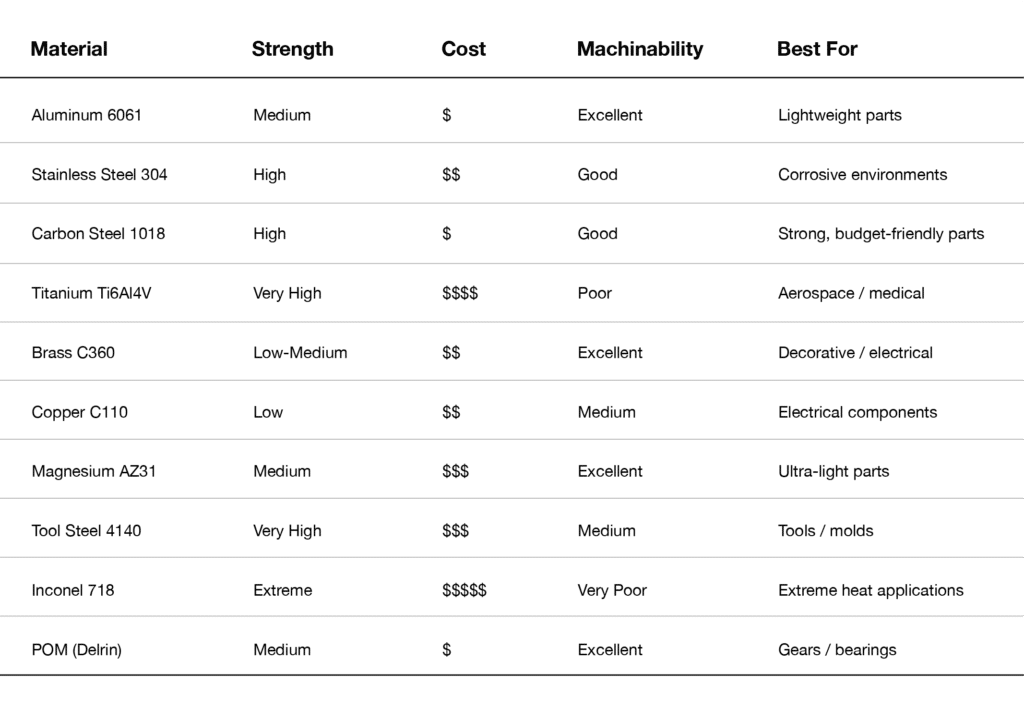
Quick Material Comparison

zone3Dplus CNC Materials Cmparison

Quick Material Comparison

1. Aluminum (6061, 7075)

  • Properties: Lightweight, corrosion-resistant, and strong for its weight.
  • Why Choose: Cuts quickly, reducing machining costs. Can be anodized for durability and aesthetics.
  • Challenges: Softer than steel, needs lubrication to avoid chip buildup.
  • Uses: Aircraft fittings, drone frames, electronics cases, bicycle parts.

2. Stainless Steel (304, 316, 303)

  • Properties: Resists rust, handles stress, and polishes well.
  • Why Choose: Ideal for wet or corrosive environments.
  • Challenges: Hard on tools; requires slower feeds and speeds.
  • Uses: Medical instruments, marine parts, food-processing equipment.

3. Carbon Steel (1018, 1045)

  • Properties: Strong, affordable, weldable.
  • Why Choose: Delivers strength at a low cost.
  • Challenges: Rusts if uncoated.
  • Uses: Structural frames, gears, bolts.

4. Titanium (Ti6Al4V)

  • Properties: Twice the strength of steel, half the weight. Biocompatible.
  • Why Choose: Perfect for aerospace and medical use.
  • Challenges: Expensive and slow to machine.
  • Uses: Aircraft engine parts, implants, racing components.

5. Brass (C360)

  • Properties: Machines smoothly, resists corrosion, looks premium.
  • Why Choose: Fast machining, minimal tool wear.
  • Uses: Plumbing parts, musical instruments, decorative fittings.

6. Copper (C110)

  • Properties: Excellent conductor of heat and electricity.
  • Why Choose: Essential for electronics and heat exchangers.
  • Challenges: Soft, can leave burrs if tools are dull.
  • Uses: Busbars, heat sinks, electrical terminals.

7. Magnesium (AZ31)

  • Properties: Lightest structural metal, easy to machine.
  • Why Choose: Ideal for weight-sensitive applications.
  • Challenges: Flammable in chip form; requires careful handling.
  • Uses: Camera bodies, car seat frames, laptop housings.

8. Tool Steel (4140, D2)

  • Properties: Extremely hard, resists wear and impact.
  • Why Choose: Perfect for tooling and molds.
  • Challenges: Brittle, requires preheating before machining.
  • Uses: Injection molds, dies, cutting tools.

9. Inconel (718)

  • Properties: Maintains strength at extreme heat.
  • Why Choose: The go-to for aerospace and energy applications.
  • Challenges: Expensive, very slow to cut.
  • Uses: Turbine blades, exhaust parts, reactor components.

10. POM (Delrin)

  • Properties: Tough, low-friction engineering plastic.
  • Why Choose: Affordable, precise, and ideal for moving parts.
  • Uses: Gears, bearings, snap-fit parts.

How to Choose the Right Material

Ask yourself:

  • Will it face moisture, heat, or chemicals? → Stainless steel or titanium.
  • Does weight matter? → Aluminum or magnesium.
  • Is it for electrical or thermal use? → Copper or brass.
  • Is budget the priority? → Carbon steel or POM.

At zone3Dplus, we help you make the right choice by balancing performance, cost, and production time.

The Future of CNC Materials

  • Smart Tooling – Sensors adjusting speeds to reduce tool breakage.
  • Eco-Materials – Recycled metals and biodegradable plastics.
  • Hybrid Alloys – Lighter than aluminum, stronger than titanium.
Scroll to Top