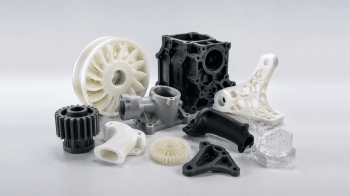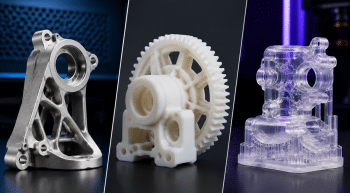
Choosing between SLS (Selective Laser Sintering) and MJF (Multi Jet Fusion) can be tricky. Both use powdered nylon to build strong, accurate parts without the need for support structures. But their differences in speed, cost, and material use can impact your project in a big way.
In this article, we’ll break down how each technology works, compare their pros and cons, and help you decide which one fits your needs. Plus, learn how zone3Dplus uses both methods to help customers create better parts faster.
How SLS and MJF Work: What’s the Difference?
SLS: A Trusted Technology Since the 1980s
SLS uses a laser to fuse layers of nylon powder. The process happens inside a heated chamber, and parts cool down slowly after printing. While reliable, this cooling stage adds time and limits how much powder you can reuse (usually only 30–50%).
MJF: HP’s Game-Changer from 2016
MJF uses inkjet heads to apply a fusing agent and a detailing agent onto powder layers. Then, infrared light melts selected areas to form each layer. Parts are cooled outside the machine, which speeds up the workflow. It also allows for up to 80% powder reuse, reducing waste.
Side-by-Side Comparison: SLS vs. MJF
Why These Differences Matter
- Strength: MJF parts often show 40% higher Z-axis strength than SLS. That’s thanks to a longer fusion time (60ms vs. SLS’s 60μs), which helps polymer chains bond more completely.
- Surface Finish: MJF parts usually have a smoother finish due to its detailing agent. SLS parts are slightly rougher and may need extra post-processing.
- Build Size: SLS supports larger builds—up to 600 x 350 x 560 mm—while MJF maxes out at 380 x 284 x 380 mm.
- Color: SLS prints are white / gray and can be dyed easily. MJF prints are typically gray or black due to the black fusing agent.
When to Choose SLS
Go with SLS if your project includes:
- Oversized parts beyond MJF’s build limits.
- Special materials like glass-filled nylon or flexible TPU.
- Short runs where material flexibility matters more than speed.
At zone3Dplus, we recommend SLS for custom jigs, fixtures, and heat-resistant components. We offer material upgrades and optimized support to reduce warping and improve dimensional accuracy.
When MJF Is the Better Choice
Choose MJF if you need:
- Fast turnaround (parts delivered in 24–48 hours).
- High-volume production with tight tolerances.
- Thin-walled or complex parts like snap fits and ducts.
- Uniform strength, especially for medical or industrial use.
zone3Dplus uses MJF for everything from fluid systems to dental RPD frameworks. Our team helps businesses optimize batch layouts and minimize part costs using MJF’s dense packing capabilities.
Real-World Use: From Aerospace to Healthcare
- Airbus uses MJF for lightweight, flight-ready HVAC ducting
- Dentists rely on it for precise, stress-resistant frameworks with sub-0.1mm accuracy.
- At zone3Dplus, we’ve helped clients in automotive and consumer electronics reduce lead times by over 50% using MJF.
What’s Next? New Trends in Powder Bed Fusion
- SLS Upgrades: Machines like Nexa3D QLS 820 offer multi-laser setups that boost print speed.
- MJF Expansion: HP is rolling out new materials—flame-retardant nylons and flexible elastomers are on the way.
- Hybrid 3D Tech: CLIP and NPJ offer exciting options for multi-material, faster printing.
Final Verdict: Match the Tech to Your Project
- Pick SLS if you need large parts, more material options, or cost-effective small batches.
- Pick MJF if you want fast delivery, better Z-strength, and lower costs for big batches.
Both methods avoid support structures, handle complex designs, and waste less than CNC machining. But if your goal is to scale fast, MJF gives you the edge.
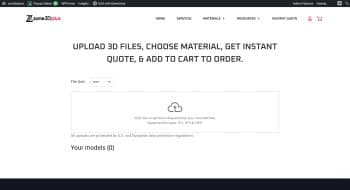
Not sure which to choose? zone3Dplus offers both SLS and MJF printing with instant quotes, expert advice, and fast global shipping. Get in touch and let’s print your next success story.
Multi Material 3D Printing: Reduce Waste Effectively
If you are researching a tool changer 3D printer, you are probably trying to solve one of two problems: printing...
Multi Material 3D Printing: How to Choose the Right Process for Functional Parts
Multi material 3D printing is changing how teams build prototypes and end-use parts. Instead of treating a printed part as...
Multi Color 3D Printer vs Full-Color 3D Printing Service: Which Is Better for Your Project?
A multi color 3D printer is one of the most searched topics in consumer and professional 3D printing right now....