If you’re new to CNC machining, you’ve probably heard of CNC milling and CNC turning. Both use computer control to shape materials like metal, plastic, or even wood. However, they work in very different ways—and choosing the right one can save you time and money. Let’s break it down in simple terms.
Core Difference: How They Work
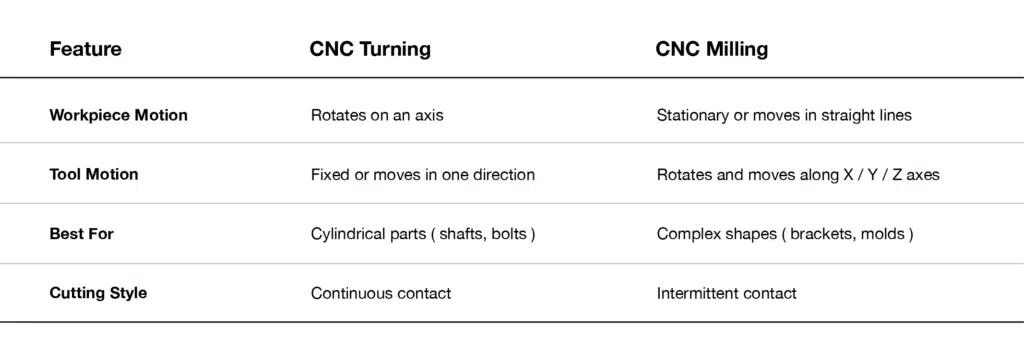
The main difference is how the tool and workpiece move:
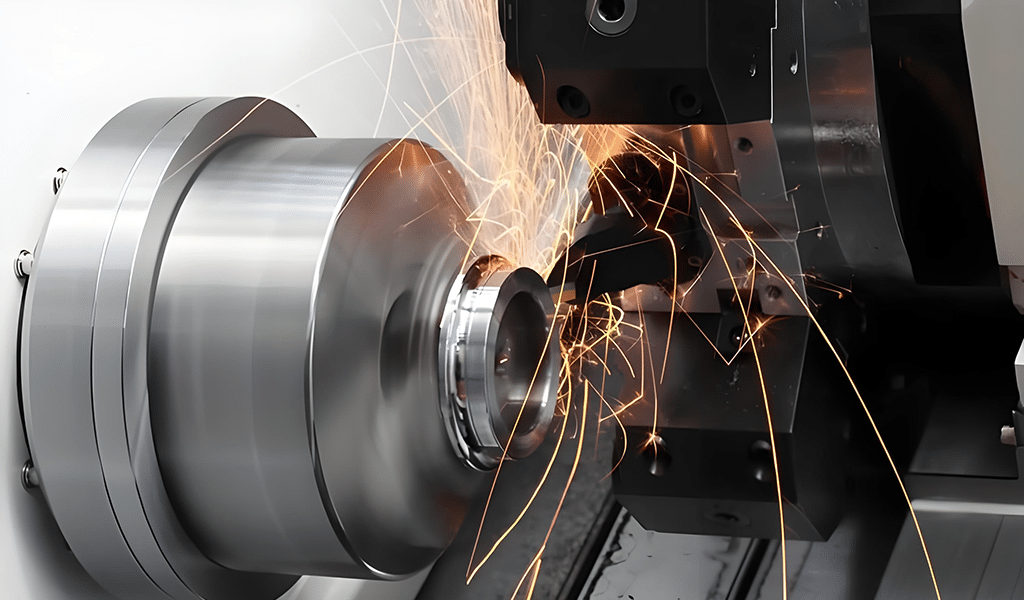
- CNC Turning – The workpiece rotates while a fixed cutting tool shapes it. Think of a potter’s wheel, but for metal or plastic. This method is great for parts with perfect symmetry, like cylinders, cones, or discs.
- CNC Milling – The cutting tool spins while the workpiece stays still or moves in a set path. The rotating tool removes material to create flat surfaces, slots, or complex 3D shapes.
1. Function & Capabilities
- Turning – Perfect for round or conical parts. It produces smooth surfaces and is ideal for items like rollers, nuts, and flanges.
- Milling – Handles complex and non-symmetrical shapes, including grooves, threads, and curved surfaces. It’s used for engine parts, medical tools, and custom brackets.
2. Tool Types
- Turning – Uses single-point tools for precision cuts.
- Milling – Uses multi-point tools like end mills and face mills for more versatility.
3. Accuracy & Finish
- Turning – Often gives smoother surfaces on round parts.
- Milling – Can achieve very tight tolerances for complex features.
4. Cost & Speed
- Turning – Usually cheaper for round parts because the setup is simpler.
- Milling – Can cost more for complex designs, but it’s faster when making multi-feature parts.
Real-World Applications
CNC Turning Examples:
- Shafts
- Hydraulic rollers
- Gun barrels
- Ball joints
CNC Milling Examples:
- Gears
- Surgical tools
- Pump housings
- Aerospace components
Which One Should You Choose?
- Choose turning if your part is round, conical, or tubular—like a bolt or pipe fitting.
- Choose milling if you need flat surfaces, pockets, or detailed shapes—like a custom bracket or gear.
- Combine both for hybrid parts—like a flanged shaft with drilled holes. Many modern CNC turn-mill centers can do both processes in one setup, saving time and cost.
How zone3Dplus Helps You Decide
At zone3Dplus, we offer both CNC milling and CNC turning under one roof—plus turn-mill hybrid machining for complex projects. This means you get:
- Faster lead times – No need to send parts between multiple shops.
- Micron-level accuracy – Perfect for aerospace, medical, and high-performance engineering.
- Cost efficiency – We choose the most suitable process (or combination) for your design, so you don’t overpay for unnecessary complexity.
Whether you need smooth cylindrical parts or intricate shapes, our team can guide you to the best manufacturing process—and deliver it with precision.
Final Takeaway
- Turning = Best for round parts.
- Milling = Best for complex shapes.
- zone3Dplus = Best for choosing the right process and getting high-quality CNC parts on time.
Multi Material 3D Printing: Reduce Waste Effectively
If you are researching a tool changer 3D printer, you are probably trying to solve one of two problems: printing...
Multi Material 3D Printing: How to Choose the Right Process for Functional Parts
Multi material 3D printing is changing how teams build prototypes and end-use parts. Instead of treating a printed part as...
Multi Color 3D Printer vs Full-Color 3D Printing Service: Which Is Better for Your Project?
A multi color 3D printer is one of the most searched topics in consumer and professional 3D printing right now....